If you’ve ever picked up a friend’s paddle and thought, Whoa, this feels completely different, you already know the answer.
Paddle weight matters. A lot.
It changes how fast your hands move at the net, how much power you get on drives, how steady your blocks feel, and how your arm feels after an hour of play. The good news is you don’t need to overthink it. Once you know the basic tradeoffs, picking the right weight is pretty simple.
Let’s take a closer look.
Paddle Weight Matters: weight changes speed, power, and comfort
You can think about paddle weight this way:
- Lighter paddles feel quicker and easier to move.
- Heavier paddles feel more stable and hit with more power.
- Midweight paddles are the sweet spot for most players.
There’s no single perfect weight for everyone. The best weight depends on your style, strength, and comfort.
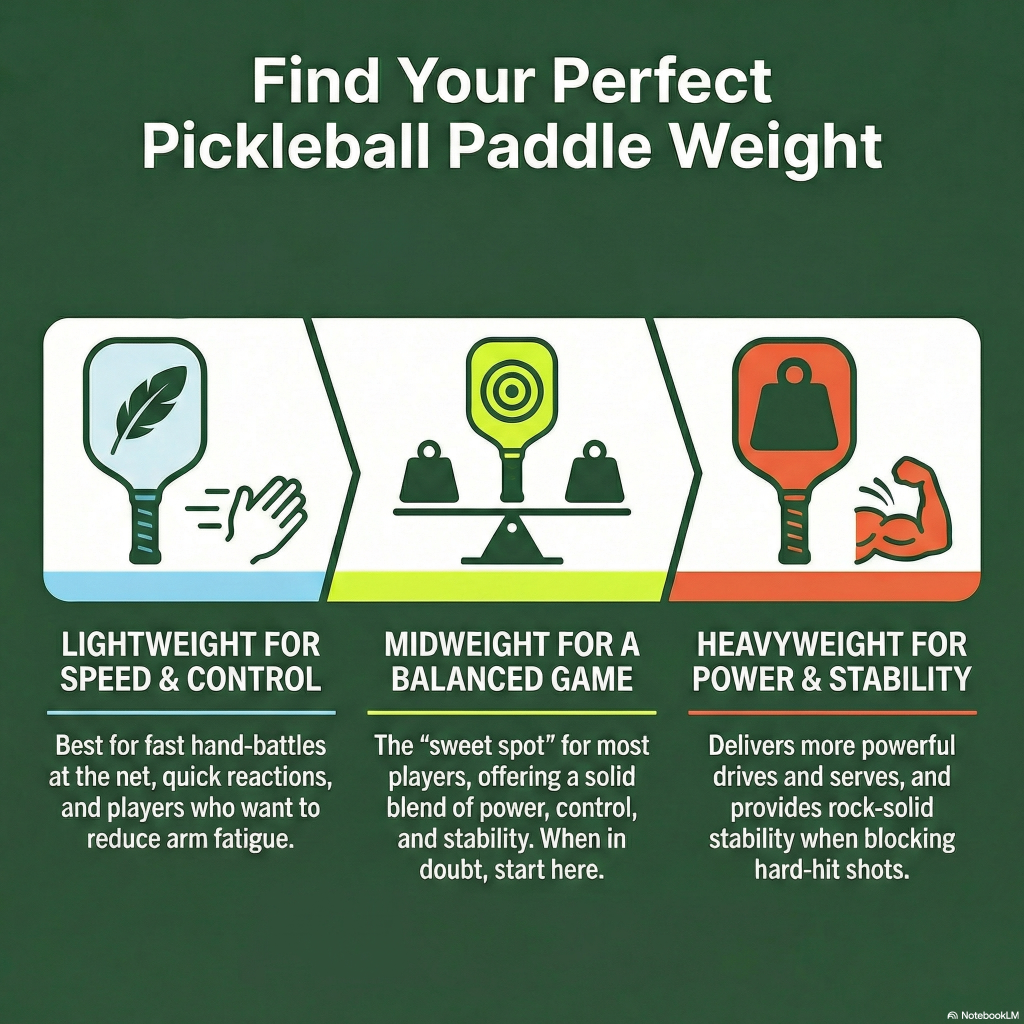
Lightweight vs. Midweight vs. Heavyweight (what it actually feels like)
Lightweight paddles
Best for: fast hands, quick reactions, lots of net play
A lightweight paddle feels like it’s always right where you need it. If you enjoy quick hand battles, fast counters, and rapid volley exchanges, this type usually feels great.
Why people love them
- Faster hands at the kitchen
- Easier to react to speed-ups
- Less tiring for long play sessions
What you might notice
- Less “free power” on drives and serves
- Blocks can feel less stable against heavy hitters
- Mishits can twist the paddle more
If you play doubles and want speed and control, a lightweight paddle can give you an edge.
Midweight paddles
Best for: all-around play, most skill levels
Midweight is the category where most people should start. It’s balanced for soft shots and strong enough for baseline drives.
Why it works for so many players
- Solid mix of power and control
- Stable enough for blocks and resets
- Quick enough for hand battles without feeling whippy
If you’re unsure what you want, midweight is the safest choice and the easiest to get used to.
Heavyweight paddles
Best for: baseline power, stability, strong countering
Heavy paddles tend to feel solid. When you swing through a drive or hit a volley, the paddle doesn’t move as much. This can give you more depth, speed, and stability when the ball comes fast.
Why players choose heavy
- More power and “plow-through” on drives and serves
- More stability on blocks, counters, and hard resets
- Often feels steadier on contact
What you need to watch
- Slower reaction speed in fast exchanges
- More fatigue if you’re playing a lot of quick volley points
- It can be tough on the arm if the paddle feels head-heavy
Heavy paddles are great for aggressive players, especially if you’re strong and like to attack. But if you already get tired or hit late, a heavy paddle can make things more complicated.
Related: How to Clean Your Pickleball Paddle
Common Paddle Weights & Play Style
| Common paddle weight (oz) | Weight category | Best for play style | What you’ll notice most |
| 6.8–7.2 | Lightweight | Fast doubles, quick hands, dinking-heavy players, speed-up counters | Faster reactions, easier hand battles, less “free power” |
| 7.3–7.5 | Light-mid | Control-focused all-court players, doubles with occasional drives | Quick at the net with a bit more stability than true light |
| 7.6–7.9 | Midweight (sweet spot) | Most players, beginners to advanced, balanced doubles/singles | Best blend of control, power, and stability |
| 8.0–8.2 | Mid-heavy | Aggressive all-court, stronger players, heavier drives and put-aways | More pop and stability, slightly slower hands |
| 8.3–8.6 | Heavyweight | Baseline power, singles emphasis, hard counters and blocks vs bangers | More plow-through and depth, more fatigue risk in long net battles |
| 8.7+ | Extra-heavy (less common) | Niche: very strong players who want maximum stability/power | Big stability and power tradeoff with noticeably slower speed |
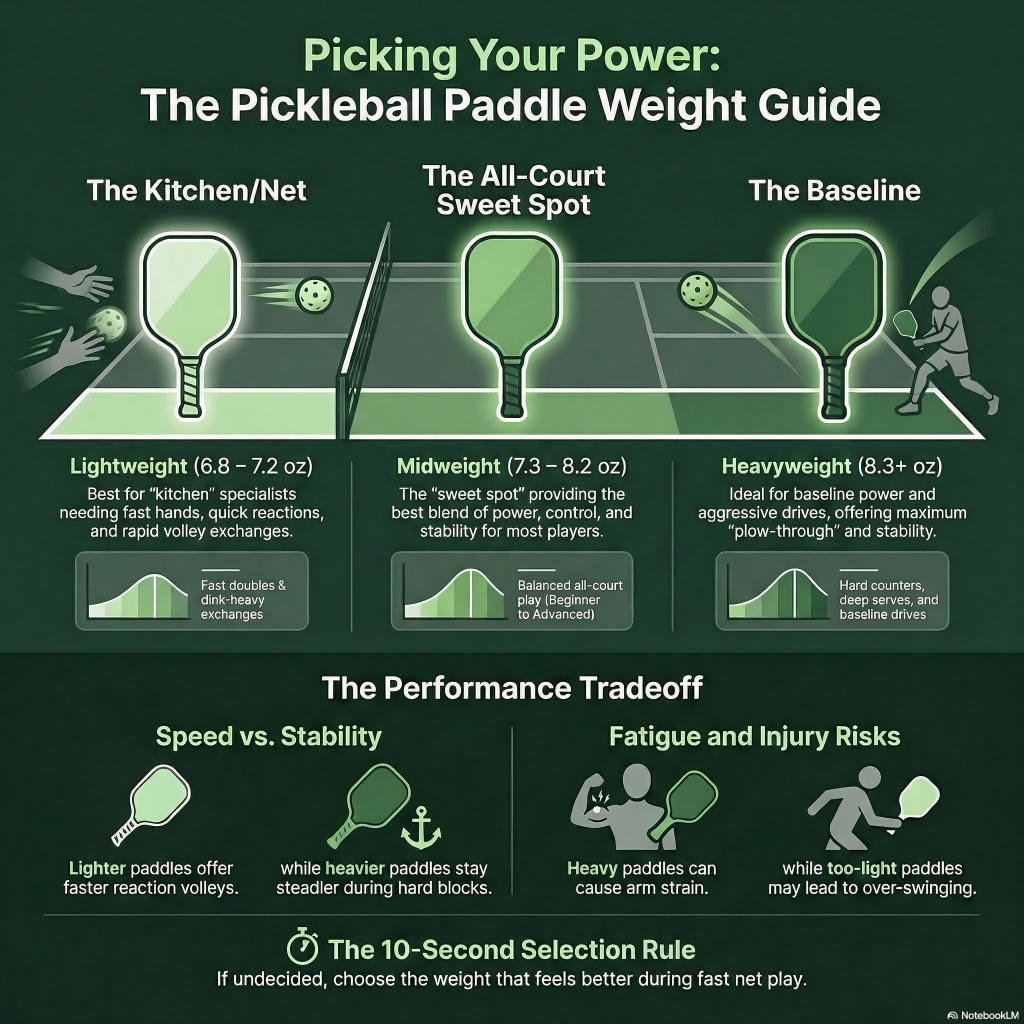
Net play vs. Baseline Power (pick your advantage)
If you live at the kitchen
If your game is built around dinks, blocks, counters, and hand speed, lighter to midweight tends to make you feel sharper. You’ll get the paddle into position faster, especially on reaction volleys.
This is the classic tradeoff:
- Lighter paddle = faster hands
- Heavier paddle = steadier blocks
If your main goal is winning fast exchanges, you’ll usually feel that benefit right away with a lighter setup.
If you win from the baseline
If you like driving, serving hard, and hitting aggressive third shots, a midweight or heavyweight paddle often feels better. More weight behind the paddle helps the ball go deeper with less effort.
You can still hit hard with a lighter paddle, but many players find they have to swing harder to get the same power, especially on serves and drives.
Related: Pickleball Paddle Buyer’s Guide
Arm Fatigue and Tennis Elbow (the part nobody wants, but everyone needs)
Paddle weight can definitely cause arm fatigue, and for some players, it can make tennis elbow worse.
The truth is, it’s not just the weight. How you swing, how tightly you grip, and how the paddle feels during contact all matter too.
When a paddle feels too heavy
You might notice:
- Your hand speed slows down late in games
- Your forearm feels cooked after play
- You’re late on blocks and counters
- You feel soreness rather than normal muscle fatigue
A heavier paddle can put more strain on your arm, especially if it feels heavy at the top. If your elbow is already sensitive, a heavier paddle might not be the best choice.
When a paddle feels too light
This surprises people, but it happens:
- Some players squeeze the grip tighter for control
- Some swing harder to create power
- That combination can also irritate the forearm and elbow
If you’re dealing with pain, your goal is to find a paddle weight that lets you swing smoothly without forcing the ball or gripping the handle too tightly.
If you have ongoing pain, it’s a good idea to talk to a doctor or physical therapist. But for many players, just finding a comfortable paddle weight and relaxing your grip can make a big difference.
Choose the right paddle weight in 10 seconds
Use this as a starting point:
- Mostly doubles and you love the kitchen? Start light to midweight for faster hands.
- You want a do-it-all paddle that’s easy to play with? Go midweight.
- You love drives, serves, and baseline aggression? Try mid to heavy.
- You fatigue easily or have elbow sensitivity? Aim for a comfortable midweight that doesn’t feel head-heavy.
If you’re choosing between two options, pick the one that feels better at the net. Most doubles points are decided there.

Two quick fixes if your paddle is close, but not perfect
You don’t always have to buy a new paddle.
1. Want more stability without going heavier overall?
Try adding a little lead tape to the sides of your paddle. This often makes blocks and resets feel more stable without making your hands much slower.
2. Want a more secure, comfortable grip?
Add an overgrip. It can help you relax your hand and avoid squeezing too hard, which is more important than most people think.
Small changes can make your paddle feel much better.
So, Does Paddle Weight Matter?
Yes, paddle weight really matters.
If you want quicker hands and smoother net play, choose a lighter paddle. If you want more stability and power from the baseline, pick a heavier one. For the easiest all-around option, go with mid-weight.
What’s the sign that you picked the right weight?
You stop thinking about your paddle and focus on the game.