There is nothing more satisfying in pickleball than a clean speedup.
You wait at the kitchen. Your opponent floats one just a little too high. You snap your paddle forward, catch them off guard, and win the point before they even have time to react.
Beautiful.
But here is the problem.
Most players do not lose points because they speed up.
They lose points because they speed up at the wrong time, from the wrong position, on the wrong ball.
A good speedup can help you take control of the point. A bad speedup is basically a handwritten invitation for your opponent to counterattack, body bag you, and make you question every life choice that led you to that moment.
So, let’s talk about when to speed up, when to leave it alone, and how to stop turning “aggressive pickleball” into “free points for the other team.”
What Is a Speedup in Pickleball?
A speedup is when you take a slower ball, often near the kitchen, and attack it quickly.
Instead of continuing the dink rally, you change the pace. You hit the ball faster, usually toward your opponent’s body, paddle-side hip, shoulder, or an open gap.
The goal is simple: make your opponent react under pressure.
A good speedup can:
- Surprise your opponent
- Force a weak counterattack
- Create a pop-up
- Win the point outright
- Shift momentum in your favor
But a speedup is not just “hit the ball hard.”
That is where a lot of players get into trouble.
A smart speedup is controlled, intentional, and based on the ball in front of you. A bad speedup is rushed, emotional, and usually happens because you got bored dinking.
And yes, we have all been there.
Why Pickleball Players Love Speedups
Speedups are fun.
They make you feel aggressive. They create highlight moments. They can make a slow point feel exciting in half a second.
They also feel like a shortcut.
Instead of patiently building the point, moving your opponent around, and waiting for the right ball, you can just attack now.
That is tempting.
Especially if you are playing against someone who loves long dink rallies. After six or seven dinks, your brain starts whispering dangerous things:
“Do something.”
“End this.”
“You have hands.”
“This is your moment.”
And suddenly, you are speeding up a ball from below the net directly into someone’s waiting paddle.
Point over. Not for you.
The Biggest Speedup Mistake: Attacking Balls That Are Too Low
This is the mistake that costs players the most points.
They speed up balls that are below the net.
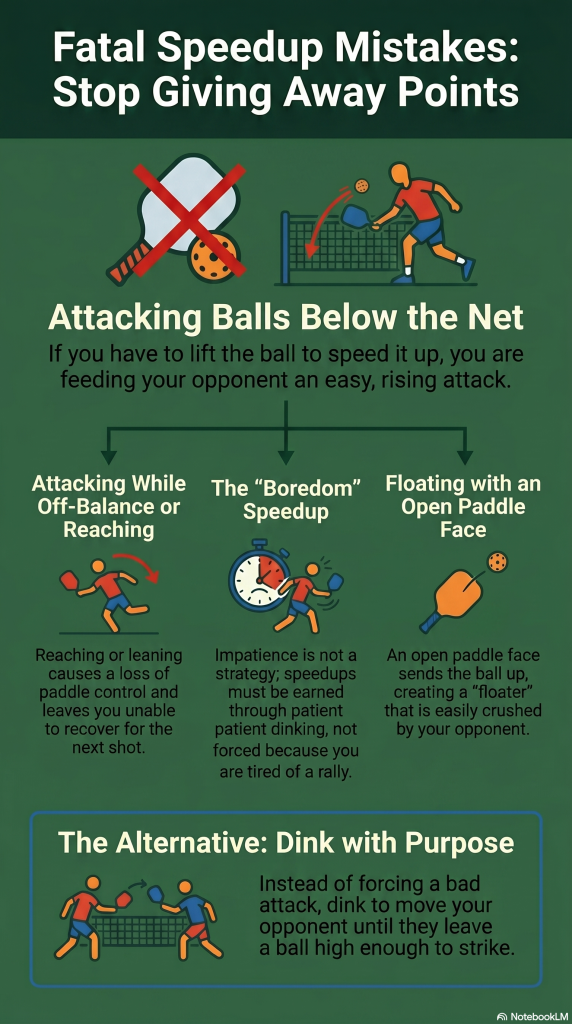
When the ball is below the net, you usually have to hit up on it. That means your opponent gets a ball that is rising, attackable, and often coming right into their strike zone.
In other words, you thought you were attacking.
But really, you were feeding them.
A good rule of thumb:
If you have to lift the ball to speed it up, it is probably not the right ball to attack.
That does not mean you can never attack a low ball. Advanced players can roll, disguise, and place low speedups in ways that create pressure. But for most recreational players, attacking from below the net creates more problems than it solves.
If the ball is low, your better option is usually to dink, reset, or move the ball to a better spot.
Boring? Maybe.
Effective? Absolutely.
Bad Speedup Signs
Not every ball deserves to be attacked. Some balls are just sitting there, minding their own business, hoping you make a bad decision.
Here are signs you should probably not speed up.
You’re Off-Balance
If your feet are messy, your speedup probably will be too.
Speedups require control. If you are leaning, reaching, falling backward, or stretched too wide, you are not in a great position to attack.
A rushed speedup from bad balance usually leads to:
- A ball into the net
- A ball out of bounds
- A weak attack
- An easy counterattack
Before you speed up, ask yourself: am I stable?
If the answer is no, reset the point.
The Ball Is Below the Net
This is the big one.
If the ball is low, you are probably hitting up. If you are hitting up, your opponent may be able to attack down.
That is not a trade you want.
Look for balls that sit a little higher. You do not need a giant pop-up. You just need enough height to attack without lifting the ball into trouble.
You’re Reaching
A reaching speedup is rarely as good as it feels in your head.
When you reach, you lose control of your paddle face. You also lose the ability to disguise your shot or recover quickly after contact.
That matters because a speedup does not always end the point. Sometimes your opponent gets it back.
If you speed up while reaching and they counter, you may not be ready for the next ball.
Your Paddle Face Is Too Open
An open paddle face sends the ball up.
That is fine for a dink or reset, but it can be dangerous on a speedup.
If your paddle face is too open, your attack may float. And a floating speedup is one of the easiest balls for your opponent to crush. Popping up a dink never helps you win the point…
Keep the motion compact. Think controlled pressure, not giant swing.
You’re Attacking Just Because You’re Bored
This one hurts because it is true.
A lot of bad speedups happen because players get impatient.
They are tired of dinking. They want action. They want to be the one who ends the point.
So they attack a ball that did not deserve to be attacked.
Patience is not passive. In pickleball, patience is often how you earn the right to be aggressive.
When Should You Speed Up in Pickleball?
A good speedup usually starts with a good opportunity.
You are not forcing the attack. You are taking what the point gives you.
Here are better times to speed up.
When the Ball Sits High
This is the easiest one.
If your opponent leaves a dink too high, you can attack without having to lift the ball.
That gives you a better chance to keep your speedup low, direct, and uncomfortable.
You do not need to swing as hard as possible. In fact, a controlled speedup is often better than a wild one.
Your goal is not always to hit a winner. Sometimes your goal is to force a weak response.
When Your Opponent Is Out of Position
If your opponent is leaning, reaching, moving, or recovering from a previous shot, a speedup can put them under pressure.
This is especially true if you have moved them wide with a dink, then attack the next ball into their body or the open space.
Good pickleball is not just about hitting hard.
It is about making your opponent uncomfortable at the right time.
When There Is a Gap in the Middle
In doubles, the middle can be a great target. Not always, but often.
If both players hesitate, or if there is confusion over who should take the ball, a speedup through the middle can create chaos.
Just be careful not to attack a ball that is too low or too easy for the stronger counterattacker.
The middle is useful, but it is not magic.
RELATED: How to communicate with your pickleball partner.
When You Can Aim at the Body
A body speedup can be very effective because it gives your opponent less room to extend.
Instead of aiming right at their paddle, aim at awkward spots:
- Paddle-side hip
- Dominant shoulder
- Chest
- Right elbow area
- The space between the body and paddle
These targets can jam your opponent and make it harder for them to counter cleanly.
The goal is not to be reckless or dangerous. Keep it controlled and appropriate for the level of play.

Where Should You Aim a Speedup?
A speedup needs a target.
“Hit it hard somewhere” is not a strategy. Here are some better options.
The Paddle-Side Hip
This is one of the best targets because it can jam your opponent.
Many players are comfortable when the ball comes right to their paddle. But when the ball comes toward the hip or elbow area, they have to make a quick decision.
Backhand? Forehand? Move out of the way? Block?
That hesitation is what you want.
The Dominant Shoulder
A speedup toward the shoulder can be awkward, especially if your opponent is crowding the kitchen line.
It can force a late reaction and create a pop-up.
Just make sure you are in control. You are trying to pressure the player, not launch a ball at someone’s face.
The Middle Gap
If you are playing doubles, the middle can work well when both opponents are unsure who should take the ball.
This is especially useful when one player is stronger than the other. You can aim toward the seam between them and make them communicate under pressure.
The Open Space
Sometimes the best speedup is not at the body. It is into open court.
If your opponent is leaning one direction or leaving space exposed, use it.
Again, the point is not just power. It is placement.
What to Do Instead of Speeding Up
One of the best ways to improve your speedups is to stop speeding up so much.
That sounds weird, but it works. When you attack fewer balls, you usually attack better balls.
Here are better options when the speedup is not there.
Dink With Purpose
Do not just dink to keep the ball in play.
Dink with a plan.
Move your opponent wide. Change depth. Aim at their outside foot. Make them bend. Make them hit up.
A good dink can create the speedup opportunity you wanted in the first place.
Reset the Point
If you are under pressure, reset.
There is no shame in keeping the point alive.
A reset gives you time to recover, get balanced, and work your way back into the rally.
A lot of players lose points because they try to turn defense into offense too quickly.
Sometimes the smartest shot is the one that gets you back to neutral.
Let Your Opponent Make the Bad Decision
This is underrated.
If your opponent is impatient, you do not have to force anything. Keep the ball low. Stay steady. Make them be the first person to panic.
A lot of points are won because one player simply refuses to be the first one to do something dumb.
That is not boring pickleball.
That is winning pickleball.
How to Practice Better Speedups
You do not need to stop attacking. You just need to train better decision-making.
Here are a few simple ways to practice.
Drill 1: Only Speed Up High Balls
Play a dink game where you are only allowed to speed up balls that are clearly above net height.
If the ball is low, you must dink.
This trains patience and helps you recognize better attack opportunities.
Drill 2: Pick One Target
For one game or drill, choose one speedup target.
For example, only attack the paddle-side hip.
This helps you stop swinging randomly and start aiming with intention.
Drill 3: Speedup and Expect the Counter
A lot of players speed up and then freeze. Do not assume your attack is ending the point.
Practice speeding up, then immediately getting ready for the next ball. Keep your paddle up. Stay balanced. Expect the counter.
The best players are not just good at starting hands battles. They are ready for the second and third shot too.
Drill 4: Count Your Bad Attacks
During a rec game, quietly track how many points you lose from forced speedups.
Not all missed attacks are bad decisions. Sometimes you chose the right ball and missed. That happens.
But if you notice that most of your errors come from attacking low balls, reaching balls, or boredom balls, you have your answer.
The Real Secret: Speedups Should Be Earned
A speedup is not a panic button.
It is not something you do because the rally got too slow.
A good speedup is earned.
You earn it by staying patient, keeping the ball low, moving your opponent, and waiting for a ball you can actually attack.
That is the difference between smart aggression and reckless aggression.
Smart aggression says, “That ball is attackable.” Reckless aggression says, “I’m tired of dinking.”
And pickleball has a funny way of punishing the second one.
Your highlight reel can wait. Your scoreboard will thank you.